Key points in 30 seconds
- The rotator cuff is a group of 4 tendons that stabilise the shoulder and allow you to lift and rotate your arm. The supraspinatus is by far the most commonly affected.
- Tears are very common with age: they are found in roughly 20 to 30% of people over 60, often with no pain at all.
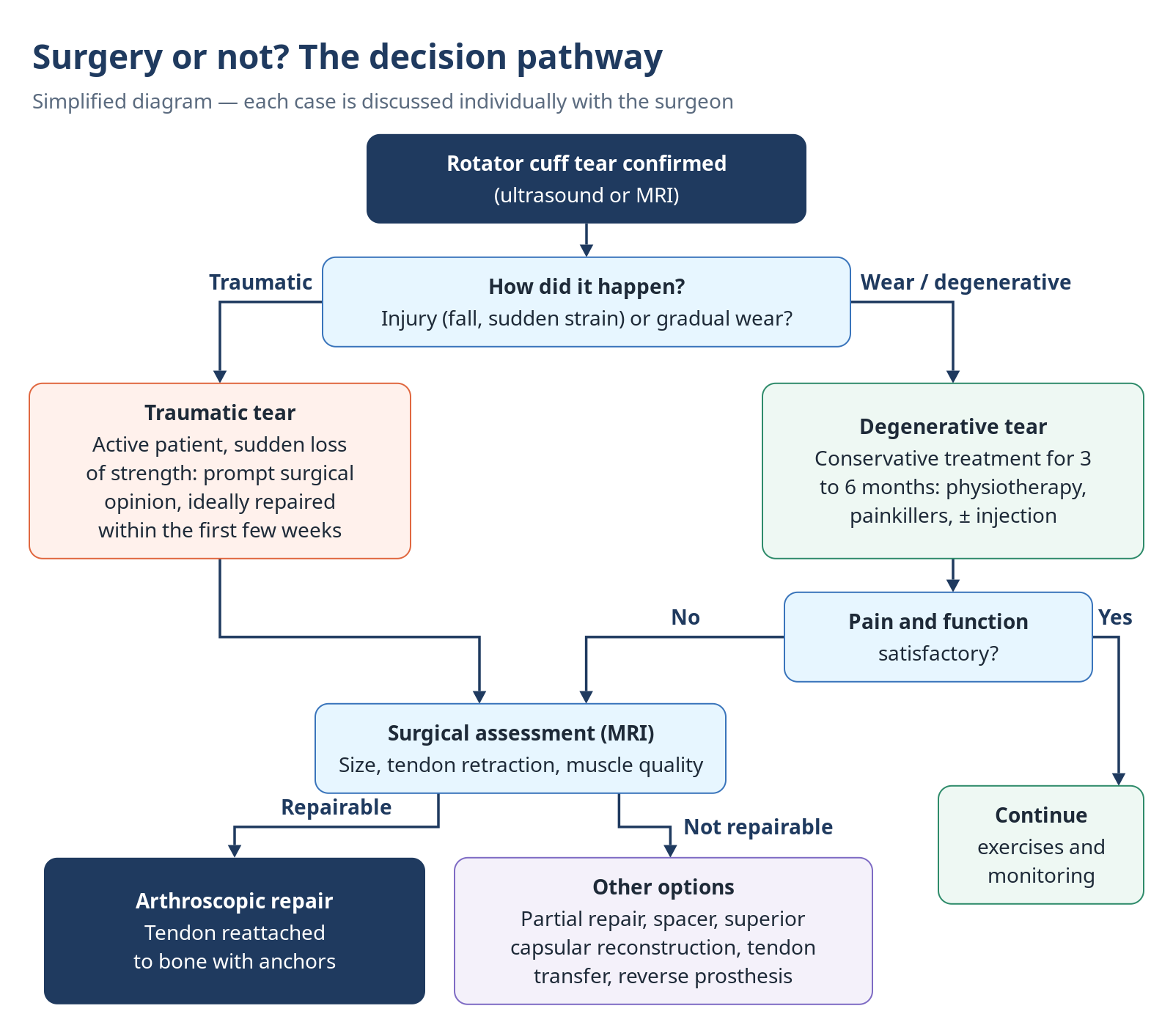
- Not every tear needs surgery. A wear-and-tear (degenerative) tear is first treated with physiotherapy for 3 to 6 months.
- A traumatic tear (fall, sudden strain) in an active person calls for a prompt surgical opinion: over time the tendon retracts and the muscle deteriorates.
- The standard operation is arthroscopic repair; full recovery takes 6 to 12 months.
What is the rotator cuff?
The shoulder is the most mobile joint in the body. This freedom comes at a price: the head of the humerus, a large "ball", sits on a very shallow bony socket (the glenoid). It is mainly the muscles and tendons of the rotator cuff that keep it centred during movement.
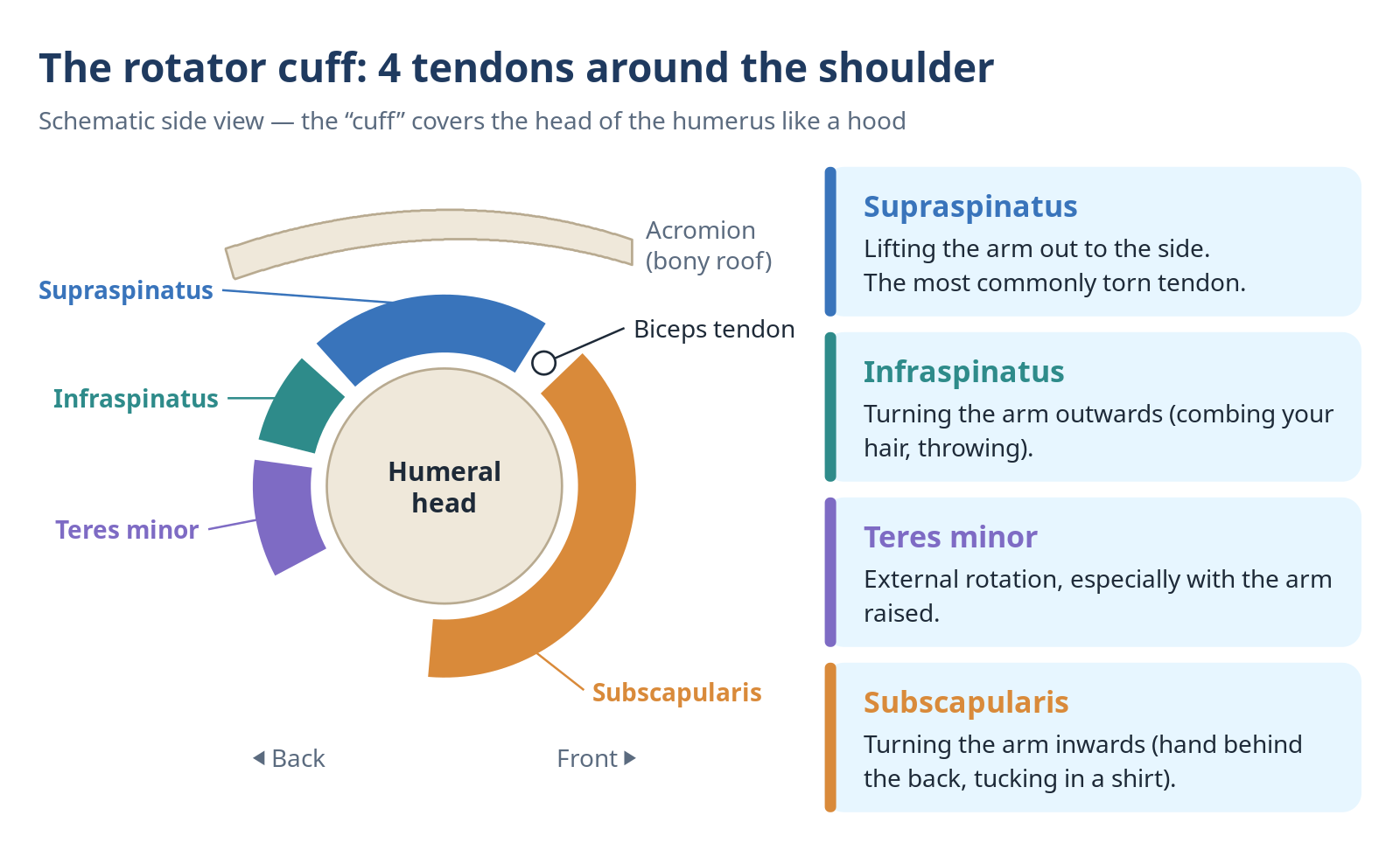
The cuff is made up of four muscles whose tendons cover the humeral head like a hood: the supraspinatus (lifting the arm), the infraspinatus and the teres minor (turning the arm outwards) and the subscapularis (turning the arm inwards). Just above lies the acromion, the bony "roof" of the shoulder.
Why does the tendon tear?
There are two main mechanisms, and they guide the whole treatment:
- Degenerative (wear-and-tear) tear — the most common type, after the age of 50. The tendon gradually thins and splits, sometimes without symptoms for years. Risk factors: age, smoking, diabetes, high cholesterol, repetitive overhead work, throwing sports.
- Traumatic tear — a fall onto the arm, a shoulder dislocation or a sudden strain (catching a heavy load) tears a tendon that was previously healthy or only slightly damaged. It also affects younger, sporty people.
In practice, many tears are mixed: a moderate injury "finishes off" a tendon that was already weakened.
What are the symptoms?
- Pain on the outer side of the upper arm, sometimes down to the elbow, more than in the shoulder itself.
- Night pain: being unable to sleep on the affected side — this is often the symptom that makes people see a doctor.
- Pain when raising the arm, especially between shoulder height and eye level (getting dressed, doing your hair, reaching for something on a shelf).
- Loss of strength or the arm tiring quickly; with large tears, being unable to lift the arm actively ("pseudoparalytic shoulder").
Warning sign: after a fall or a sudden strain, sharp pain followed by a sudden inability to lift the arm should be seen by a doctor within the following days, rather than waiting several weeks.
How is a rotator cuff tear diagnosed?
The clinical examination remains the foundation: the surgeon tests the strength of each tendon separately (lifting against resistance, external rotation, internal rotation) and checks for stiffness, which would point to another cause (frozen shoulder).
| Test | What it shows |
|---|---|
| X-ray | Looks for arthritis, calcification or upward migration of the humeral head (a sign of an old, large tear). |
| Ultrasound | Quick, radiation-free and dynamic. Very reliable for confirming a full-thickness tear and monitoring how it evolves. |
| MRI (or MR arthrogram) | The key test before deciding on surgery: size of the tear, tendon retraction and, above all, muscle quality (fatty infiltration). |
Types of rotator cuff tear
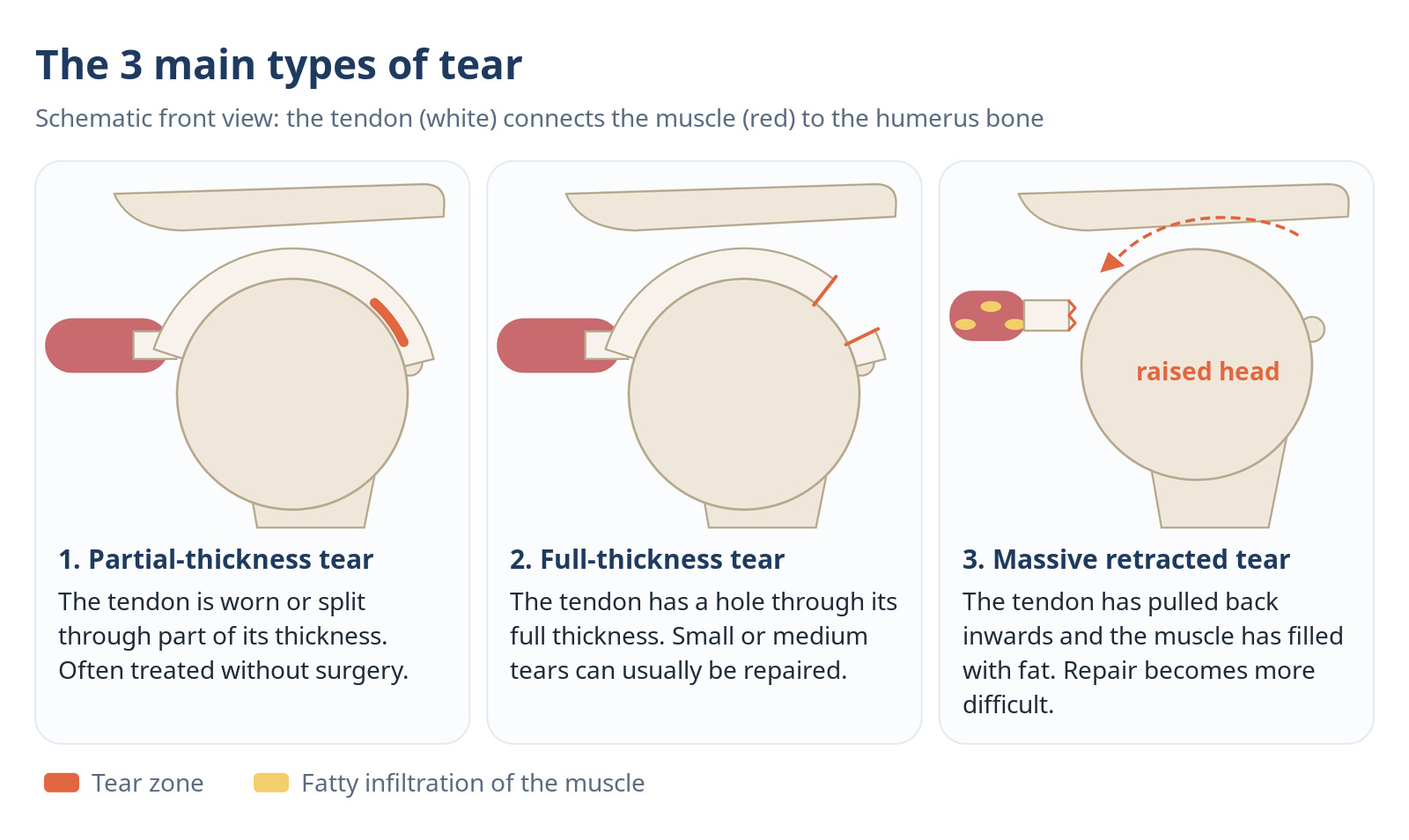
A partial-thickness tear affects only part of the tendon's thickness. A full-thickness tear creates a hole right through it; it is graded by size: small (< 1 cm), medium (1 to 3 cm), large (3 to 5 cm) or massive (> 5 cm or at least two tendons). The older and larger a tear, the more the tendon retracts and the more the muscle turns into fat — a change that is largely irreversible.
Non-surgical treatment: who is it for and how does it work?
For a degenerative tear, conservative treatment is the first step, for 3 to 6 months:
- Physiotherapy: the cornerstone. It strengthens the remaining tendons, the deltoid and the shoulder-blade muscles to "compensate" for the torn part.
- Painkillers and anti-inflammatories for short periods, with temporary adjustment of activities.
- Corticosteroid injection: effective for short-term pain relief; the number should be limited, as repeated injections can weaken the tendon.
In patients over 55 with a small non-traumatic supraspinatus tear, randomised trials show comparable medium-term results between physiotherapy and surgery. However, a full-thickness tear does not heal on its own: about half of tears get larger within a few years, and new or worsening pain is often a sign of this enlargement. Clinical and ultrasound follow-up is therefore recommended.
When should a rotator cuff tear be operated on?
The decision is never based on imaging alone, but on pain, functional limitation, physiological age, activities and tendon quality. Surgery is generally offered in the following situations:
- Traumatic full-thickness tear in an active person: ideally repaired within the first few weeks, before the tendon retracts.
- Failure of properly conducted conservative treatment over 3 to 6 months (persistent pain or weakness).
- Relatively young patient (under 60–65) with a full-thickness tear, because the risk of enlargement is high and repair is more reliable while the muscle is still in good condition.
- Tear that gets larger during follow-up, or marked loss of strength.
- Significant subscapularis tear, which makes the shoulder unstable towards the front.
| Conservative treatment more likely | Surgery more likely |
|---|---|
| Partial-thickness tear or small wear-and-tear tear | Traumatic full-thickness tear |
| Older, less active patient, strength preserved | Active patient, manual worker, athlete |
| Good response to physiotherapy | Failure of 3 to 6 months of properly conducted treatment |
| Muscle already heavily infiltrated with fat (old tear) | Muscle still in good condition on MRI |
Why not wait too long? A torn tendon retracts and its muscle wastes away. Beyond a certain stage, repair becomes difficult or even impossible, and the risk of re-tear increases. For a traumatic tear, early repair is associated with better results.
What happens during rotator cuff surgery?
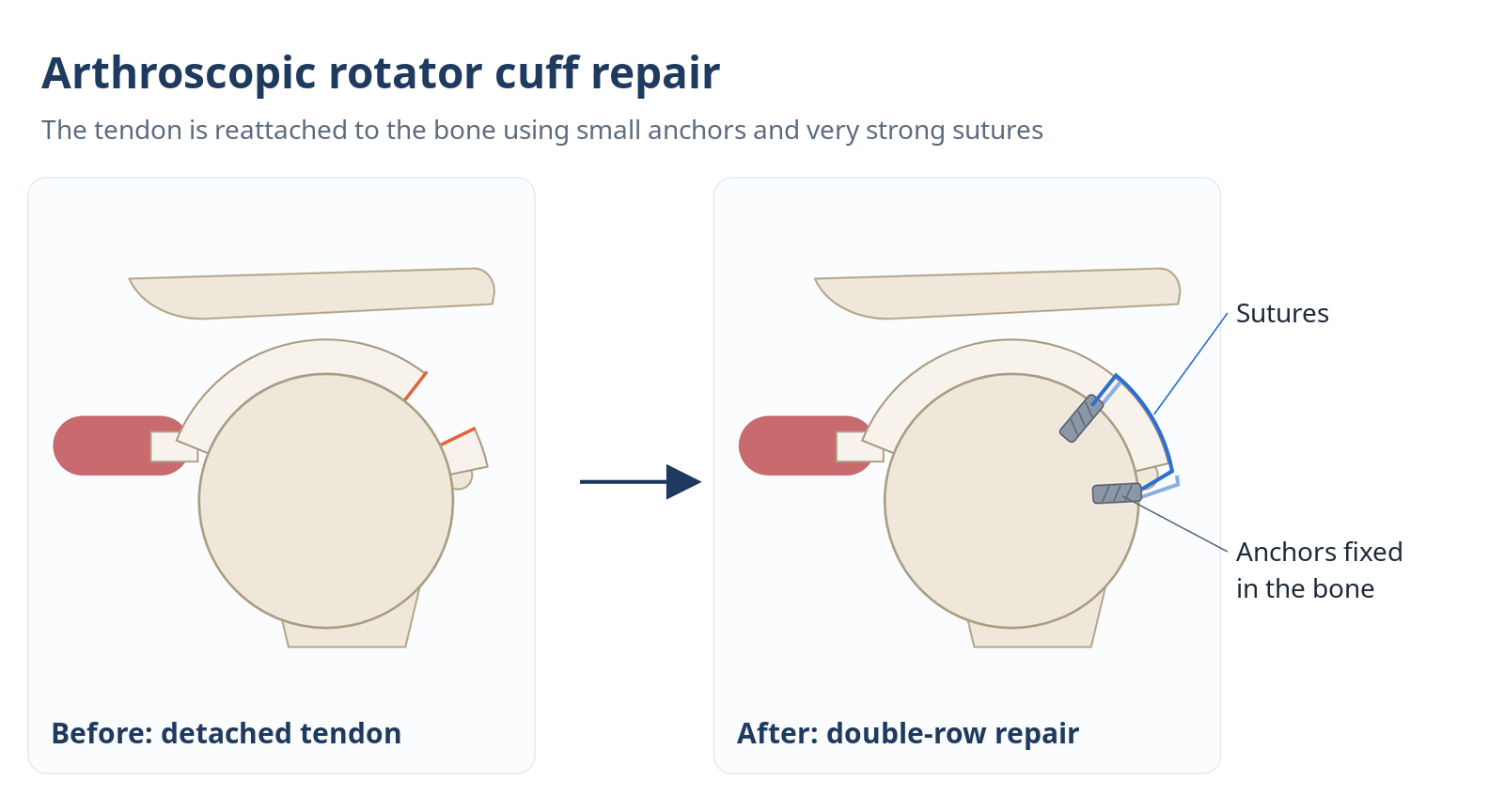
Arthroscopic repair is the standard technique. Through 3 or 4 small incisions of less than one centimetre, the surgeon inserts a camera and fine instruments, frees the tendon, prepares the bone surface and reattaches the tendon to its insertion site using small anchors loaded with very strong sutures (single-row or double-row repair).
- General anaesthesia combined with a regional anaesthetic block of the arm (nerve block), which greatly reduces pain in the first few hours.
- The operation takes about 1 to 2 hours, followed by a short hospital stay.
- Common additional procedures: treatment of the biceps tendon (tenotomy or tenodesis), smoothing of the acromion if needed.
Results: the vast majority of patients end up with a shoulder that is much less painful and works much better. The risk of re-tear depends mainly on the size of the tear, age and muscle quality: around 10% for small tears, it can reach 40% or more for massive tears — and a re-tear is not always painful.
What if the tear cannot be repaired? Other options exist depending on age and the condition of the joint: partial repair, subacromial balloon (spacer), superior capsular reconstruction, tendon transfer or, when arthritis is also present ("cuff tear arthropathy"), reverse total shoulder replacement.
After surgery: how long does recovery take?
The repaired tendon needs time to heal onto the bone. Rehabilitation therefore follows precise stages: protection in a sling for 4 to 6 weeks, gradual recovery of movement, then strengthening. Pain, especially at night, improves markedly after the first few weeks; the final result is assessed at 6 to 12 months.
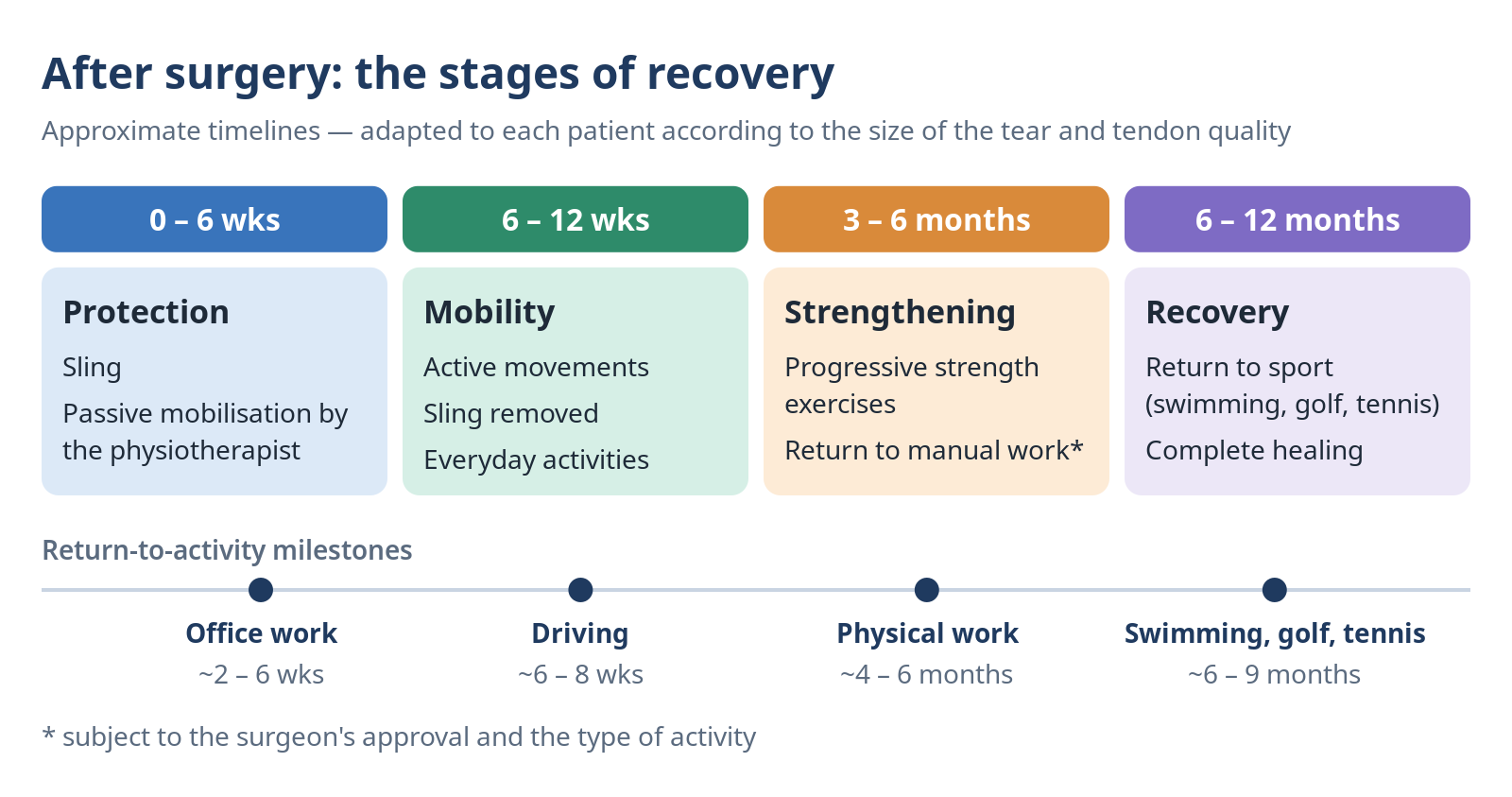
| Period | Stage | What it involves |
|---|---|---|
| 0 – 6 wks | Protection | Sling · Passive mobilisation by the physiotherapist |
| 6 – 12 wks | Mobility | Active movements · Sling removed · Everyday activities |
| 3 – 6 months | Strengthening | Progressive strength exercises · Return to manual work* |
| 6 – 12 months | Recovery | Return to sport (swimming, golf, tennis) · Complete healing |
* subject to the surgeon's approval and the type of activity
| Return-to-activity milestones | Approximate timeline |
|---|---|
| Office work | \~2 – 6 wks |
| Driving | \~6 – 8 wks |
| Physical work | \~4 – 6 months |
| Swimming, golf, tennis | \~6 – 9 months |
When should you see a shoulder specialist?
- Shoulder pain that persists beyond 4 to 6 weeks despite rest and painkillers.
- Repeatedly waking at night because of the shoulder.
- Loss of strength or inability to lift the arm, especially after a fall or a sudden strain.
Dr. med. Erik Montesinos, an orthopaedic surgeon specialising in shoulder arthroscopy, sees patients in Riaz (canton of Fribourg) and Montreux (canton of Vaud), serving patients from the Gruyère, Veveyse, Riviera and Chablais regions.
This article is for information only and does not replace a medical consultation. Each situation must be assessed individually.
Frequently asked questions
Can a rotator cuff tear heal without surgery?
Ultrasound or MRI: which test should I have?
Is there an age limit for surgery?
How long will I be off work after surgery?
Is rotator cuff surgery painful?
In Switzerland, is a rotator cuff tear covered by accident insurance?
When can I return to sport?
References
- Haute Autorité de Santé (HAS). Prise en charge des tendinopathies rompues de la coiffe des rotateurs. Recommandation, 2026.
- Keener JD et al. Patterns of tear progression for asymptomatic degenerative rotator cuff tears. J Shoulder Elbow Surg, 2015.
- Mall NA et al. Symptomatic progression of asymptomatic rotator cuff tears. J Bone Joint Surg Am, 2010.
- Kukkonen J et al. Treatment of nontraumatic rotator cuff tears: a randomized controlled trial with two years of clinical and imaging follow-up. J Bone Joint Surg Am, 2015.
- Longo UG et al. Retear rates after rotator cuff surgery: a systematic review and meta-analysis. BMC Musculoskelet Disord, 2021.
- Loi fédérale sur l'assurance-accidents (LAA), art. 6 al. 2.